
Following the previous article on stress, this article focuses on strain.
Strain is another extremely important concept in Strength of Materials. It is one of the basics, but that is exactly why you want to understand it properly from the beginning.
So in this article, we will go through what strain means, how it is defined, what symbols and units are used, and how it relates to stress.
For the explanation of stress, check out the article below:
 What Is Stress? Understand Normal & Shear Stress and How to Calculate Them in 10 Minutes
- Strain is a parameter that represents the amount of deformation. More precisely, it represents the ratio of deformation, not the absolute amount of deformation.
- There are two main types of strain: normal strain and shear strain.
- Strain is basically dimensionless, so it does not have a unit. However, shear strain is often expressed in rad because it represents a change in angle.
- The strain values we deal with in Strength of Materials are usually very, very small.
- For the type of deformation mainly covered in Strength of Materials, namely elastic deformation, stress and strain are related by Hooke’s law.
渾身のnoteを書きました!!

「公式は覚えてるのに問題を見たら手が止まる…」
そんなあなたは『解法の型・流れ』を理解できていないのです。材料力学は色々な問題がありますが、実は決まった型に沿って解くことができ、この型こそが材力の基礎であり極意であると言えます。
このnote記事は、本ブログ管理人のぽるこが「材料力学の問題を解く上での型・要点・コツ」を本気でまとめあげました。かなりの大ボリュームかつエッセンスを詰め込んだものですが、1,200円という映画1本分にも満たない価格設定としました。
本ブログに書ききれていない内容も多く含んでおりますので、ぜひ読んでみてください!
Contents
- What Is Strain? — A Parameter That Represents the Amount of Deformation
- Types and Symbols of Strain — Normal Strain and Shear Strain
- Definition of Strain — Deformation per Unit Length
- Typical Strain Values in Strength of Materials — They Are Really Small
- Relationship Between Stress and Strain — Understanding Hooke’s Law Properly
- Summary
Just like stress, the word strain may be something you hear for the first time when you start studying Strength of Materials at university.
Personally, I do not think strain is as tricky as stress, but it is still a very important concept. So let’s go through the key points properly.
First of all, what exactly is strain?
Simply put, strain is a parameter that represents how much a material deforms.
But here is the important part:
Strain represents the ratio of deformation, not the absolute amount of deformation.
In other words, strain does not simply tell us “how many millimeters the material stretched.”
Instead, it tells us how much the material changed compared with its original length.
Take a look at the figure below.
There is a long bar and a short bar, and both of them are stretched. As shown in the figure, the absolute elongation is larger for the long bar than for the short bar.
However, when we look at strain, meaning the ratio of deformation, the short bar actually has the larger value.
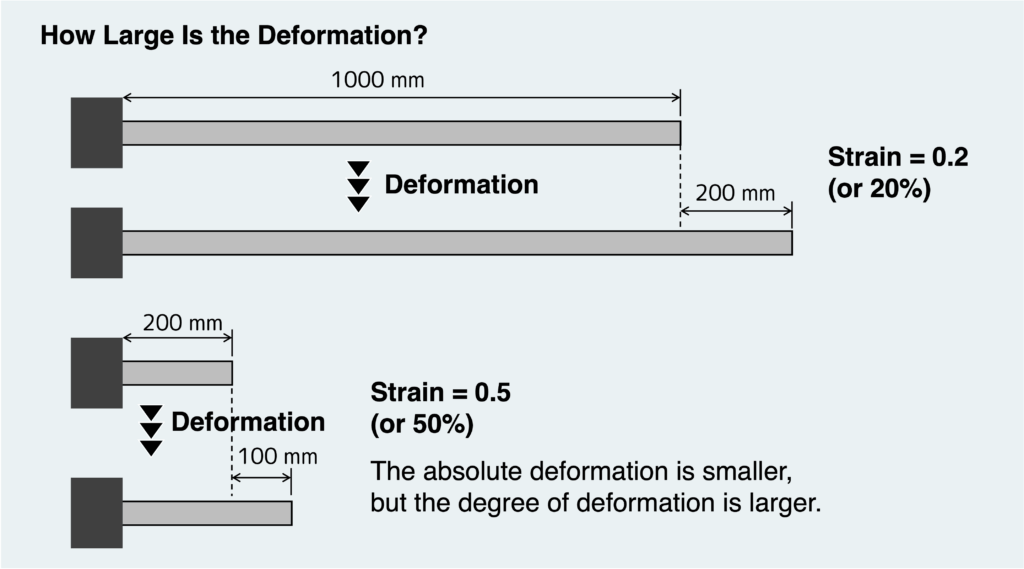
For example, suppose the material can stretch up to 60% before fracture. In that case, the short bar is clearly closer to failure.
But if you only look at the absolute elongation, you cannot make that judgment properly.
That is why, when discussing how much a material has deformed, it is usually more appropriate to use strain rather than the absolute amount of deformation.
Of course, there are also situations where the absolute deformation itself matters. The key is to use them properly depending on what you want to evaluate.
Now let’s look at the different types of strain.
Just as stress can be divided into different types, strain can also be classified into a few categories. In general, the types of strain correspond to the types of stress.
In other words:
- Strain caused by normal stress (in the direction of that stress) is called normal strain.
- Strain caused by shear stress is called shear strain.
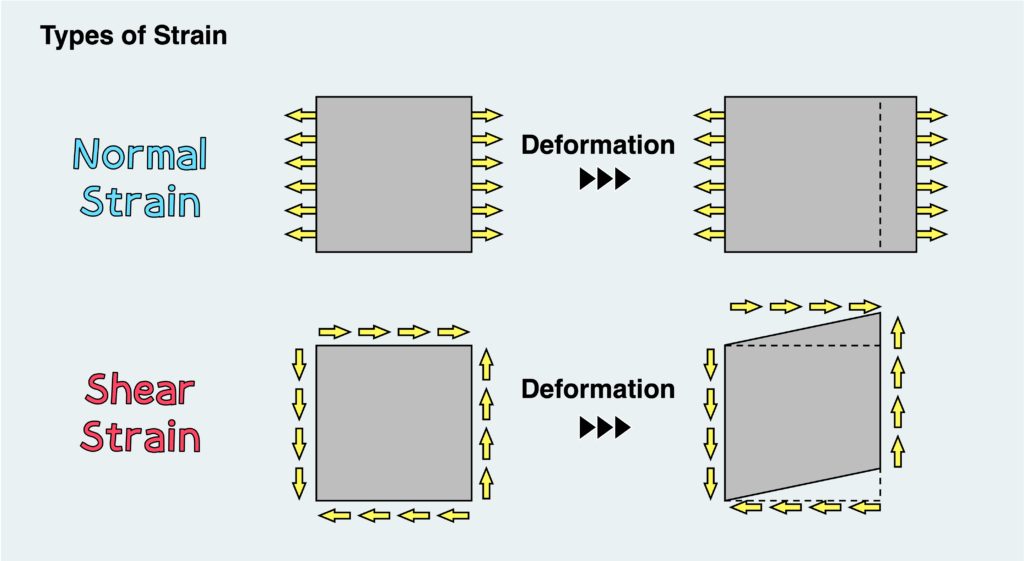
Normal strain is the kind of deformation where a shape stretches or contracts while basically keeping the same shape.
For example, imagine a square becoming longer or shorter while still remaining a square.
Shear strain, on the other hand, is deformation in which the shape becomes distorted.
For example, a square may deform into a slanted shape, meaning the angles change and the original shape is no longer preserved.
This is much easier to understand visually than through words alone, so take a close look at the figure below and make sure the difference is clear.
You may also hear the term bending strain in some cases. This refers to the strain distribution caused by bending stress.
However, if you focus on one specific point in the material, the deformation occurring there is still, in the end, normal strain. So strictly speaking, you do not really need to count bending strain as a separate basic type of strain.
So for now, it is enough to understand that there are two main types of strain:
- Normal strain
- Shear strain
Normal strain is represented by ε (epsilon), and shear strain is represented by γ (gamma).
For normal strain, the direction is usually shown with a subscript, such as εx or εy.
For shear strain, the notation is a little different. Since shear strain is related to shear stress, which acts as a set on four faces as shown in the figure above, it is written using two subscripts, such as γxy.
Now let’s move on to how strain is actually expressed.
Strain tells us how much a material changes per unit length.
So, it is obtained by dividing the amount of deformation by the original length.
In simple terms:
Strain = deformation / original length
Since strain is calculated by dividing a length by another length, the units cancel out.
That means strain has no unit.
So strain is usually written as values like 0.001 or 0.0001.
That said, writing and reading numbers like this all the time can be a bit annoying. Tiny decimals everywhere… not exactly friendly.
Because of that, strain is often expressed using [%].
The percent notation is probably familiar already.
For example, a strain of 0.1 can also be written as 10%. This is often used when dealing with relatively large deformation.
However, for shear strain, the situation is slightly different. As explained below, shear strain eventually represents a change in angle, so it is often expressed in radians [rad].
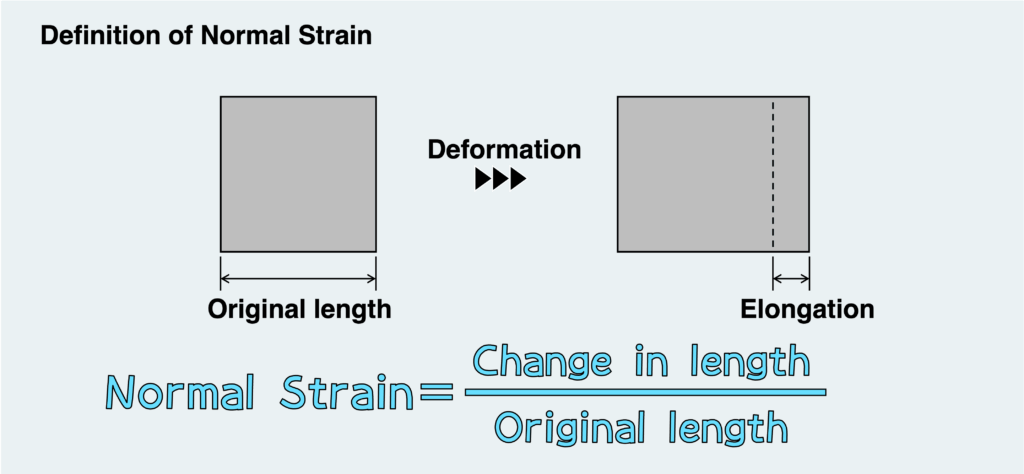
Normal strain represents the amount of deformation that occurs when a material is stretched or compressed by normal stress.
The definition of normal strain ε is shown in the figure below.
Shear strain represents the amount of deformation that occurs when a material is distorted by shear stress.
Unlike normal strain, which deals with stretching or compression, shear strain describes how much the shape itself changes — for example, when a square element deforms into a slanted shape.
The definition of shear strain γ is shown in the figure below.
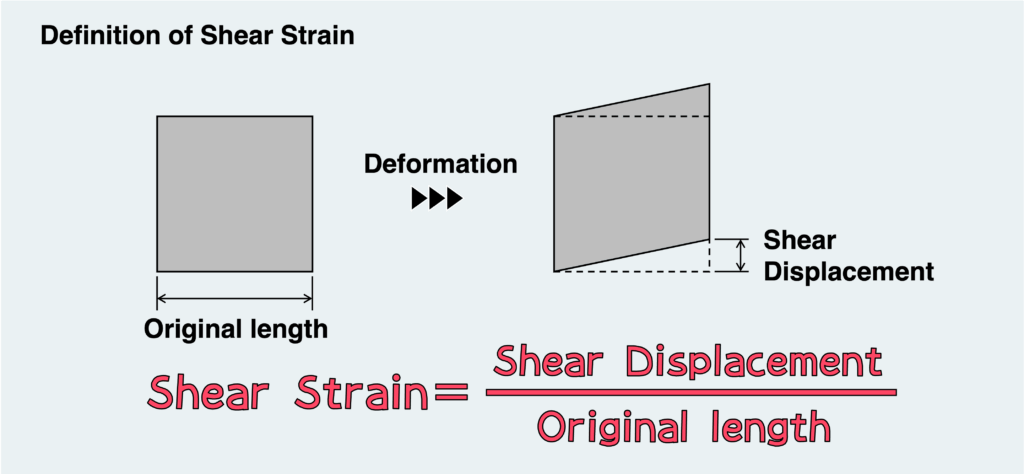
The definition can be written as shown above.
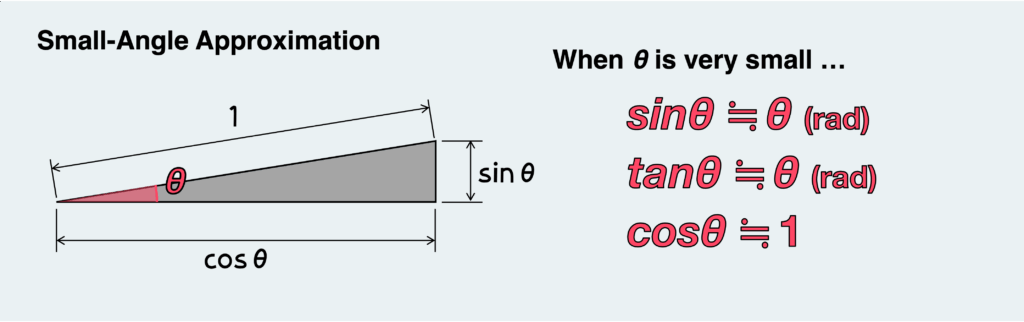
However, in Strength of Materials, the deformation we usually deal with is extremely small. Because of that, we can use a common small-angle approximation.
The approximation is shown below.
Using this angle approximation, we get the following result.
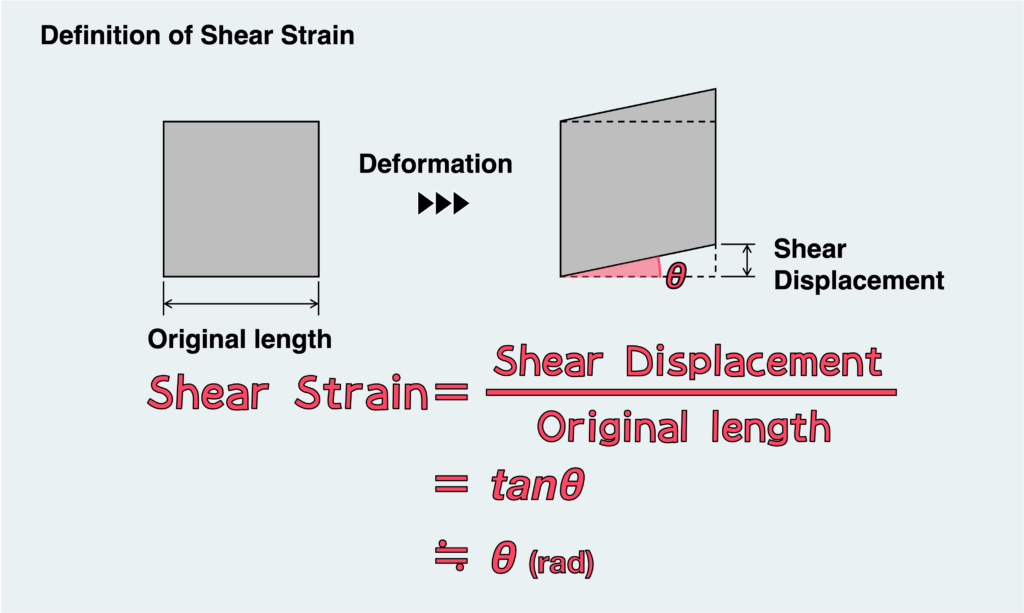
So in the end, shear strain γ represents the change in angle itself.
One important point here is that this angle change is measured in radians (rad), not in degrees (°).
As we will touch on again later, deformation of materials can be divided into elastic deformation and plastic deformation.
In Strength of Materials, we basically deal with the range of elastic deformation, where the amount of deformation is small.
When a load is applied to a material, there is a region where the material deforms in proportion to the magnitude of the load, according to Hooke’s law. We will come back to Hooke’s law later.
This region is called the elastic deformation range.
The key feature of elastic deformation is that the material returns to its original shape when the applied load is removed.
However, if the load continues to increase, the material eventually reaches the limit of elastic deformation and starts to deform plastically. This transition point is called yielding.
In Strength of Materials, we usually deal with the range before yielding occurs, meaning the elastic deformation range.
Of course, the exact value depends on the material, but for many common metals, yielding occurs at a strain of around 0.002.
So as a rough guideline, the strain values that appear in Strength of Materials are often on the order of 10⁻⁴ (0.0001) to 10⁻³ (0.001).
Now, how small is that in real life?
Very small. Like, “you probably won’t see it with your eyes” small.
For example, suppose a bar with a length of 50 cm stretches uniformly. If the strain is 0.001, the change in length, or elongation, is only 0.5 mm.
That should give you a sense of just how tiny the deformation usually is.
On the other hand, plastic deformation refers to larger deformation that occurs after yielding. In this case, even if the load is removed, the material does not return to its original shape.
You may have seen a piece of metal bent permanently out of shape. That is an example of plastic deformation.
The plastic deformation range is usually not covered in basic Strength of Materials, at least at the undergraduate level. Instead, it belongs more to a slightly different field called plasticity or plastic mechanics.
If you imagine how a material deforms, it makes sense that there is a relationship between the magnitude of the load applied to the material and the amount of deformation.
Even without studying Strength of Materials, you probably know from everyday experience that the larger the load, the more the material deforms.
In Strength of Materials, this relationship is described by Hooke’s law.
Hooke’s law states that stress and strain are proportional. For normal stress and normal strain, this relationship is written as:
σ = Eε
Here, E is the proportionality constant that indicates how strong this relationship is. It is called Young’s modulus, or the modulus of elasticity.
You should understand that Young’s modulus E represents how difficult it is for a material to deform. It is a material property determined by the type of material.
For materials, especially metals commonly used in mechanical engineering, deformation can be divided into elastic deformation and plastic deformation.
The important point is this:
Hooke’s law is valid only in the elastic deformation range.
Once the material goes beyond the elastic range and starts to deform plastically, Hooke’s law no longer applies.
The same idea also applies to shear stress and shear strain. In this case, the proportionality constant is G, called the shear modulus or modulus of rigidity.
So the relationship is written as:
τ = Gγ
Summary
Just like stress, strain is one of the most fundamental physical quantities in Strength of Materials.
Make sure you understand the key points covered in this article, especially the idea that strain represents a ratio of deformation, not simply the absolute amount of deformation.
Once you get comfortable with both stress and strain, the next topics in Strength of Materials will become much easier to follow.
- Strain is a parameter that represents the amount of deformation. More precisely, it represents the ratio of deformation, not the absolute amount of deformation.
- There are two main types of strain: normal strain and shear strain.
- Strain is basically dimensionless, so it does not have a unit. However, shear strain is often expressed in rad because it represents a change in angle.
- The strain values we deal with in Strength of Materials are usually very, very small.
- For the type of deformation mainly covered in Strength of Materials, namely elastic deformation, stress and strain are related by Hooke’s law.
渾身のnoteを書きました!!
「公式は覚えてるのに問題を見たら手が止まる…」
そんなあなたは『解法の型・流れ』を理解できていないのです。材料力学は色々な問題がありますが、実は決まった型に沿って解くことができ、この型こそが材力の基礎であり極意であると言えます。
このnote記事は、本ブログ管理人のぽるこが「材料力学の問題を解く上での型・要点・コツ」を本気でまとめあげました。かなりの大ボリュームかつエッセンスを詰め込んだものですが、1,200円という映画1本分にも満たない価格設定としました。
本ブログに書ききれていない内容も多く含んでおりますので、ぜひ読んでみてください!