

In the previous articles, we looked at stress and strain separately.
In this article, we’re going to connect the dots and take a closer look at the relationship between the two. Along the way, we’ll also briefly introduce one of the most common material tests: the tensile test of a round bar.
Want to review stress first? Check out this article:
 What Is Stress? Understand Normal & Shear Stress and How to Calculate Them in 10 Minutes
Want to learn more about strain? This one is for you:
 What Is Strain? Definition, Formula, Units, and Stress–Strain Relationship Explained
- Hooke’s law is not a universal rule. It only applies while a material is undergoing elastic deformation.
- When stress is applied to a material, strain initially increases in proportion to the stress. This type of deformation is called elastic deformation, and the material returns to its original shape when the load is removed.
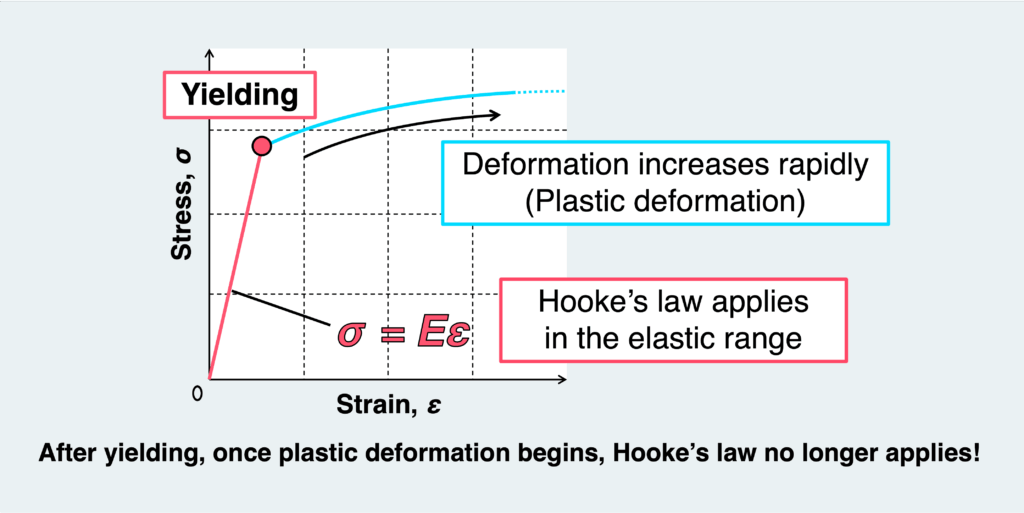
- Eventually, the material reaches the limit of elastic deformation. This point is called yielding.
- After yielding, the material moves into a region of much larger deformation. At this stage, stress and strain are no longer proportional. This deformation does not disappear even after the load is removed, and it is called plastic deformation.
渾身のnoteを書きました!!
「公式は覚えてるのに問題を見たら手が止まる…」
そんなあなたは『解法の型・流れ』を理解できていないのです。材料力学は色々な問題がありますが、実は決まった型に沿って解くことができ、この型こそが材力の基礎であり極意であると言えます。
このnote記事は、本ブログ管理人のぽるこが「材料力学の問題を解く上での型・要点・コツ」を本気でまとめあげました。かなりの大ボリュームかつエッセンスを詰め込んだものですが、1,200円という映画1本分にも満たない価格設定としました。
本ブログに書ききれていない内容も多く含んでおりますので、ぜひ読んでみてください!
As you probably guessed, the key phrase in this article is Hooke’s law.
But honestly, that’s not the main point I want to make here.
What I really want to say is this:
Don’t blindly assume that “the relationship between stress and strain = Hooke’s law.”
The main takeaway of this article is that Hooke’s law is only one limited part of how materials deform. When dealing with stress and strain, their original definitions should always come first.
I say this a lot, but simply memorizing formulas and theorems is risky. Being able to say, “Oh yeah, this equation relates this value to that value,” is not enough.
What really matters is understanding:
- what the equation actually means
- when it can be used
- and where its limits are
In other words, you need to understand the conditions behind the equation. Formulas are useful tools, but only when you know which drawer they belong in. Otherwise, you’re basically using a wrench as a spoon.
So, let’s take a closer look at the background behind Hooke’s law.
To keep things simple, we’ll use the example of pulling a round bar in tension and think about the relationship between the applied load, or stress, and the resulting deformation, or strain.
First, let’s picture the situation.
Imagine applying more and more tensile load, or stress, to a bar. As the load increases, the material stretches more and more. In other words, its strain increases.
That may sound obvious, but this kind of mental image is extremely important.
What we want to do is turn that image into equations so we can handle it mathematically. But with only this information, we’re still far from obtaining a useful relationship between stress and strain.
After all, there are countless functions where one variable increases as another variable increases. Just knowing that “stress goes up, strain goes up” is not enough.
So, how can we get more meaningful information?
There is a limit to what we can figure out just by thinking in our heads. When that happens, the best move is simple:
actually pull the bar and measure both the applied load and the amount of deformation.
In other words, we do an experiment.
If you’re a mechanical engineering student, you’ll probably encounter this in a materials testing lab during your second or third year at university. Here, we’ll briefly go through the basic idea of a tensile test and use it to understand the relationship between stress and strain.
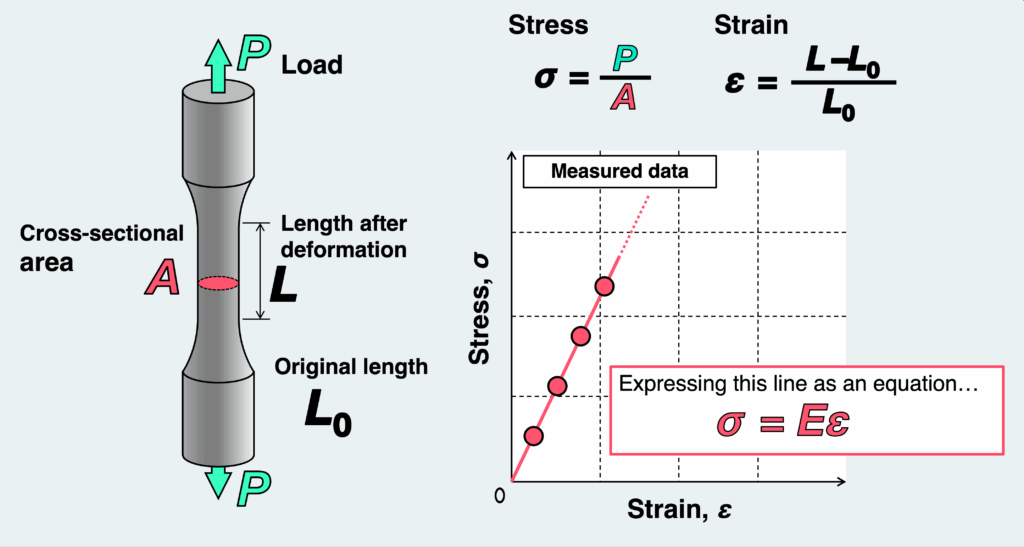
A metal specimen, shaped so that stress and strain can be measured properly, is gripped at both ends by a tensile testing machine. This specimen is often called a test piece or test specimen.
The testing machine has a sensor that measures the load acting on the specimen. The deformation is measured using a device called an extensometer, which is attached near the center of the specimen.
One end of the specimen, either the upper or lower side, is firmly fixed so it cannot move. The other end is then moved little by little, while the load and deformation are measured continuously.
From the measured load, we calculate stress.
From the measured deformation, we calculate strain.
When we plot these values on a graph, we obtain what is called a stress-strain curve.
This curve represents one of the most fundamental strength characteristics of a material, and it serves as the basis for many kinds of engineering design.
At First Stage, Load and Deformation Are Proportional
That’s the basic idea of the tensile test.
Now let’s talk about what kind of data we actually get once the test begins.
As the gripped end of the specimen is moved little by little, the specimen is gradually pulled, and the stress and strain are measured continuously.
For example, imagine the strain increasing like this:
ε = 0 → 2 → 4 → 6 → 8
Then the stress might increase like this:
σ = 0 → 10 → 20 → 30 → 40
These numbers are just for illustration, so I’m intentionally leaving out the units here.
What this means is simple:
stress and strain are proportional to each other.
Great news. The relationship between stress and strain can be expressed using the simplest possible kind of equation.
We can write this relationship as:
σ = Eε
This is Hooke’s law, which states that stress and strain are proportional.
So, when Hooke’s law appears near the beginning of a textbook, it is describing the stress-strain relationship in the early stage of material deformation.
Now, because Hooke’s law is just a simple proportional relationship, the equation itself is very easy.
Of course, the equation tells us that stress and strain are proportional. But here, I also want you to pay close attention to the role of E, which connects the two.
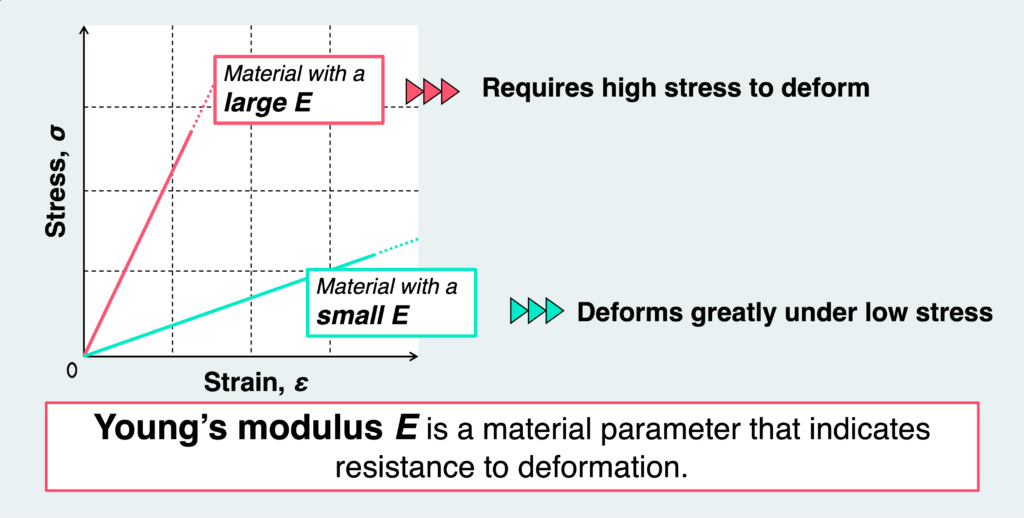
In this equation, E is the proportionality constant. It is called Young’s modulus, or the modulus of elasticity.
In a proportional relationship, the proportionality constant represents the slope of the graph.
So, when Young’s modulus E is large, the line on the stress-strain graph becomes steeper. This means that even a small amount of strain requires a large stress. In other words, the material is harder to deform.
On the other hand, when E is small, the line becomes flatter. This means the material deforms a lot even under a relatively small stress.
For a material like rubber, E is very small.
For a material like metal, E is much larger compared with rubber.
In this way, E is a material property determined by the type of material. It does not depend on the shape or size of the object.
Instead, it represents how difficult the material itself is to deform.
A material parameter that describes this resistance to deformation, such as E, is often referred to as the material’s stiffness.
Yielding and Plastic Deformation: Where Hooke’s Law Breaks Down
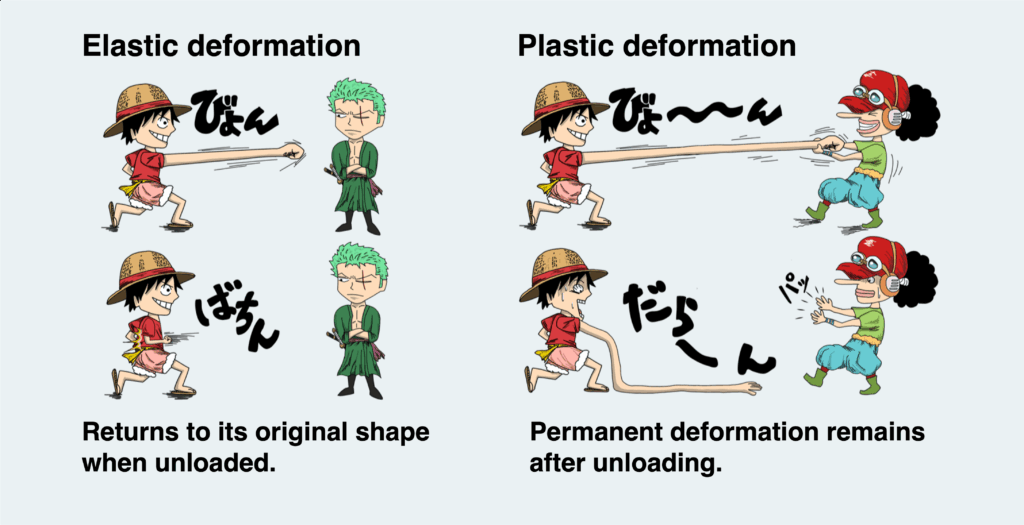
In the region where Hooke’s law applies, the amount of deformation, or strain, is relatively small. When the applied load is removed, the material returns neatly to its original shape.
This kind of small deformation that disappears after unloading is called elastic deformation.
However, if we keep pulling the material further and pass a certain point, the deformation suddenly begins to increase rapidly. The material starts to deform much more significantly.
Once the material enters this region, it no longer returns to its original shape even after the load is removed. A large amount of deformation remains.
This remaining deformation is called plastic deformation, or permanent deformation.
The phenomenon where plastic deformation begins is called yielding.
You’ve probably experienced something similar with a rubber band.
If you stretch it back and forth within a certain range, it returns to its original shape. But if you stretch it too much, it may no longer fully recover. In some cases, part of it even turns whitish and cloudy.
That is also a type of elastic and plastic deformation. The whitish cloudy part is where plastic deformation has occurred.
Now, if we add the behavior after yielding to the stress-strain curve we looked at earlier, the plastic deformation region looks something like the figure below.
As you can see, the relationship is no longer proportional.
A proportional relationship appears as a straight line on a graph. But after yielding, the stress-strain curve is no longer a straight line.
In other words:
once a material yields and plastic deformation begins, Hooke’s law no longer applies.
Strength of Materials Deals Mainly with the Early Elastic Range
If the material continues to deform after yielding, the round bar will eventually fracture.
There are actually several more stages before fracture occurs, but we’ll leave that discussion for another time.
The important point here is this:
In the early stage of deformation, where the amount of deformation is still small, the material is in the elastic deformation range. After that, once plastic deformation begins, the material starts to deform much more significantly.
And most importantly:
Hooke’s law is valid only in the elastic deformation range. Once plastic deformation begins, Hooke’s law no longer applies.
Please make sure this point really sinks in.
In Strength of Materials, stress and strain are often explained in a way that sounds like:
“Stress and strain always follow Hooke’s law!”
But that is because Strength of Materials mainly deals with elastic deformation.
So, if you’ve been thinking of Hooke’s law as some kind of universal law that describes the relationship between load and deformation in materials, it’s time to adjust that idea a little.
Hooke’s law is extremely useful, but it only works while the material is deforming elastically.
To make the point we’ve discussed so far feel a bit more concrete, let’s look at a slightly mean example problem.
First, let’s calculate the stress in part 1.
The tensile stress acting uniformly over the cross section can be obtained by dividing the internal tensile force by the cross-sectional area.
So, we can calculate it as follows:
If we use (N) for force and (mm) for length, the stress will be obtained in (MPa).\begin{eqnarray}(Stress)&=&\frac{(Internal Force)}{(Cross-Sectional Area)}\\[4pt]
&=&\frac{35.0\times10^3 (N)}{\dfrac{\pi}{4}\times10.0^2 (mm^2)}\\[4pt]
&=&446 (MPa)\end{eqnarray}
Next, let’s calculate the strain for part 2.
As usual, let’s intentionally do it the wrong way first.
The answer below is an example of what happens when someone only has Hooke’s law in their head.
Okay, we’re asked to find the strain, so we should use Hooke’s law, right?
In the previous calculation, the stress was found to be “446 MPa,” so if we divide this by Young’s modulus, we can get the strain.
\begin{eqnarray}(Strain)&=&\frac{(Stress)}{(Young’s Modulus)}\\[4pt]
&=&\frac{446 (MPa)}{206\times10^3 (MPa)}\\[4pt]
&=&0.0022\end{eqnarray}
The calculation above is not necessarily wrong right away.
Why?
Because at this point, we do not yet know whether the bar is still deforming within the elastic range, or whether it has already entered plastic deformation.
Well, in reality, since the problem says the material is steel, we can already tell that steel would never elastically stretch this much. But let’s keep the discussion fair for now.
The result of that calculation only tells us this:
“If this material were still deforming elastically at this stress level, the strain would be about this much.”
That’s all.
So, how should we calculate the actual strain?
Luckily, this problem gives us the final length of the bar after deformation.
In that case, we should calculate the strain based on its definition, rather than jumping straight to Hooke’s law.
Okay, strain is defined as the amount of deformation per unit original length.
So, we just divide the elongation by the original length.
\begin{eqnarray}(Strain)&=&\frac{(Elongation)}{(Original Length)}\\[4pt]
&=&\frac{0.22 (m)}{1.00 (m)}\\[4pt]
&=&0.22\end{eqnarray}
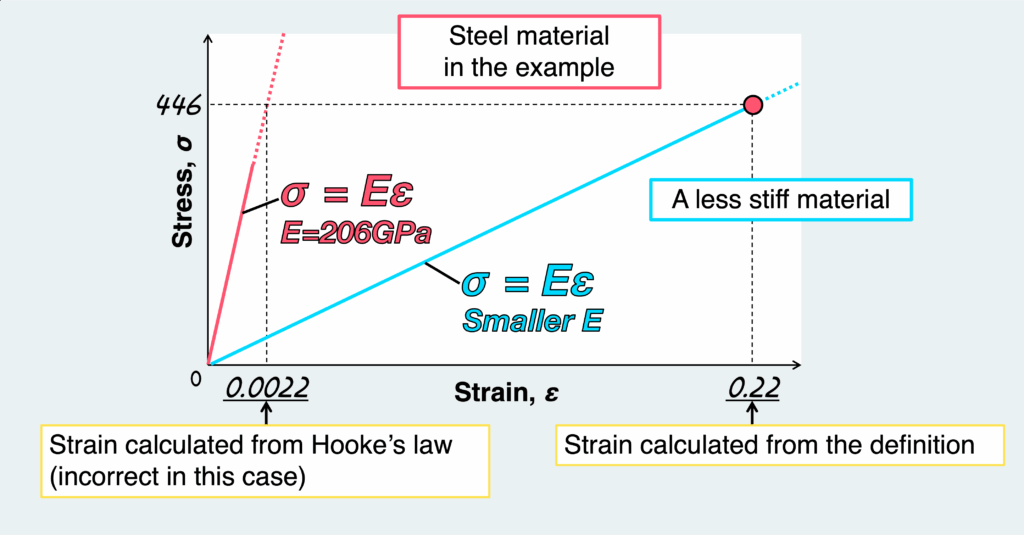
The strain calculated from the definition gives a different value from the strain calculated using Hooke’s law. And in this case, it is much larger.
When the result from Hooke’s law does not match the result from the definition, it tells us that Hooke’s law has already broken down.
In other words, this material is no longer in the elastic deformation range. It has already moved into a region of much larger deformation, which means plastic deformation.
I’ve said this several times already, but Hooke’s law only applies within the elastic deformation range.
In a case like this, the calculation based on the definition of strain takes priority.
For this problem, we are given both the original length and the final length of the bar. So we don’t need to start by thinking about Hooke’s law. We should simply calculate the strain from its definition.
If we draw this situation on a stress-strain curve, it would look something like the figure below.
The yield point is not given in the problem, so we do not know exactly where the curve bends, where yielding occurs, or where plastic deformation begins.
But one thing is clear:
the material must have gone beyond the elastic range and entered the plastic deformation region.
Of course, there may be cases where a similar problem can be solved using Hooke’s law.
But in that case, the material would not be a stiff material like metal. It would have to be a material with a much smaller Young’s modulus that can undergo large elastic deformation.
In that situation, the strain calculated from the definition and the strain calculated from Hooke’s law should match.
This would be something like the blue line in the figure below.
This example problem is a bit of a trick question. Maybe “mean” is the better word.
But it is actually a good problem for checking whether you truly understand Hooke’s law and the stress-strain relationship.
So, make sure you remember this:
Hooke’s law is valid only in the elastic range.
And when calculating stress or strain, the calculation based on the original definition comes first.
We’ve gone through this topic step by step, so hopefully it feels much clearer now.
The main message of this article is simple:
Hooke’s law is not a universal law. It applies only while the material is undergoing elastic deformation.
This may sound obvious once you hear it, but it’s surprisingly easy to miss.
So, when stress is applied to a material, make sure you understand how the strain actually changes as the material deforms.
That understanding is much more important than just memorizing the equation.
- Hooke’s law is not a universal rule. It only applies while a material is undergoing elastic deformation.
- When stress is applied to a material, strain initially increases in proportion to the stress. This type of deformation is called elastic deformation, and the material returns to its original shape when the load is removed.
- Eventually, the material reaches the limit of elastic deformation. This point is called yielding.
- After yielding, the material moves into a region of much larger deformation. At this stage, stress and strain are no longer proportional. This deformation does not disappear even after the load is removed, and it is called plastic deformation.
渾身のnoteを書きました!!
「公式は覚えてるのに問題を見たら手が止まる…」
そんなあなたは『解法の型・流れ』を理解できていないのです。材料力学は色々な問題がありますが、実は決まった型に沿って解くことができ、この型こそが材力の基礎であり極意であると言えます。
このnote記事は、本ブログ管理人のぽるこが「材料力学の問題を解く上での型・要点・コツ」を本気でまとめあげました。かなりの大ボリュームかつエッセンスを詰め込んだものですが、1,200円という映画1本分にも満たない価格設定としました。
本ブログに書ききれていない内容も多く含んでおりますので、ぜひ読んでみてください!